Adam Ferry
1. Congratulations on winning in the London Photography Awards! Can you share a little about yourself, what inspired you to pursue photography, and how has your journey evolved since your first shot?
Thank you so much. I’m a wildlife photographer with a strong passion for macro photography, particularly photographing insects and the tiny details of nature that often go unnoticed. What first drew me to macro photography in particular was the idea that a camera could reveal an entirely different world, one that most people walk past every day without ever seeing.
When I first started, I was simply fascinated by documenting wildlife encounters and experimenting with close-up photography. Over time, my photography evolved into trying to capture behaviour, textures, and fleeting moments that reveal the beauty and complexity of small creatures. Photography has taught me patience, observation, and respect for the natural world.
2. Can you share the story or inspiration behind your award-winning piece? How does winning this award make you feel about your journey in photography?
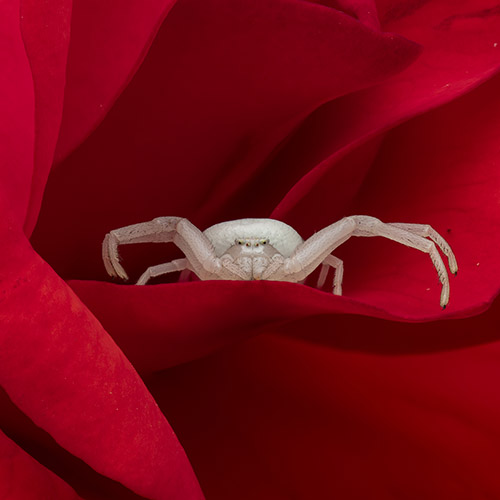
The inspiration behind the image came from wanting to highlight a moment in nature that many people would never normally notice. I found this Flower Crab Spider waiting patiently for prey to fly into the flower for the pollen. I love how I was able to capture the personality of the subject with the strong colours of the Rose flower contrasting the Spider.
What interested me most about this image was the combination of behaviour, light, and perspective. Macro photography allows you to enter a hidden world and present it in a way that feels dramatic and intimate at the same time.
Winning this award feels incredibly rewarding because wildlife and macro photography often require long hours, patience, and persistence for a single frame. Having that work recognised by an international competition feels incredible.
3. How do you decide which photo to submit for a competition?
In my photography I tend to look for strong eye catching compositions which try and convey the behaviour and personality of the subject. I want the viewer to be drawn to the image incorporating as much colour and detail as I can.
4. What first made you pick up a camera?
I’ve always been fascinated by wildlife and the outdoors, especially the smaller creatures that people tend to overlook. I started with wildlife and landscape photography before finding out more about the world of macro photography through other photographers, and by then, I was hooked.
5. What’s your favorite type of photography, and why do you love it?
Macro wildlife photography is definitely my favourite because it reveals an entirely hidden world. Insects may be tiny, but they can be incredibly expressive, complex, and visually striking when viewed up close. I love showing the behaviours and personalities of these tiny, often unseen creatures.
6. What’s your go-to camera setup, and why does it work best for your projects? What’s your favorite feature?
My go-to setup is the Olympus OM-D E-M1 Mark II paired with the M.Zuiko 90mm macro lens. I find the Micro Four Thirds system works incredibly well for macro wildlife photography because the sensor format gives excellent effective magnification while still keeping the setup lightweight and portable for long periods out in the field.
The system is especially useful when working with insects, where depth of field is extremely limited at high magnifications, with useful features like focus bracketing being invaluable.
7. If someone looked at your work, what’s the one thing you’d want them to feel?
I’d want people to feel a sense of wonder and appreciation for the smaller parts of nature that often go unseen. Also, for them to feel a connection to the creature and feel some of its personality through its behaviour and the unseen details.
8. What was the most challenging part of capturing your winning shot?
The biggest challenge was patience and timing. In macro wildlife photography, subjects are constantly moving, making focus bracketing very difficult. So shots like this require persistence and patience to wait for the perfect moment to create the shot, which is very difficult with such unpredictable subjects.
9. Is there a specific place or subject that inspires you the most?
I regularly visit a diverse range of habitats in order to find different and varied species of insect to photograph, which include places such as woodlands, meadows and heathland. I, in particular, like to visit meadows with lots of wildflowers, which attract pollinators, as this can be a great place to find interesting subjects and compositions.
10. Who or what has been your biggest influence in photography?
I follow lots of amazing macro photographers online, which is how I first found out about the amazing world of macro photography and their photos constantly inspire me.
11. What message would you share to inspire photographers to participate in photography awards, and what advice would you give to help them excel in the competition?
Photography awards are a great opportunity to share your perspective and push yourself creatively. Competitions encourage photographers to refine their work and think carefully about storytelling and impact.
My advice would be to submit images that genuinely excite you personally rather than trying to follow trends or copy what you’ve seen in other competitions.
12. What’s one piece of advice for someone just starting in photography?
With regard to macro photography and wildlife photography, understanding your subject is key; learning their individual behaviours makes it easier to predict their patterns. As well as this, it's key to learn their habitats and when they are active in order to find suitable subjects to photograph. Alongside this, it can take a while to get used to macro photography and the techniques needed, so don’t give up quickly!
13. What role do editing and post-processing play in your creative workflow?
I try to edit and post-process the images I take as little as possible to keep authenticity in my images.
14. How do you see technology, like AI, influencing the future of photography and your own approach?
Technology and AI are already improving workflows in areas like noise reduction, focus stacking, and subject detection, which can be especially useful in macro photography. I have noticed since starting macro photography that these technological changes are constantly evolving and I think it's quite important to stay aware of trends whilst still remaining authentic.
15. If you could photograph anything or anyone in the world, what would it be?
I’d love to travel to Costa Rica one day to photograph all the amazing insects and wildlife they have there! It's such a diverse ecosystem with so many different incredible and unique subjects to photograph.